
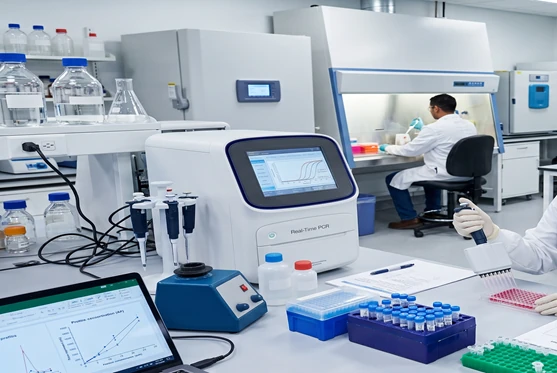
In contract research, data is the product. Sponsors, auditors and regulators rely on a contract research organisation (CRO) to deliver results that are accurate, reproducible and defensible. That trust starts with the instruments. Equipment qualification provides documented evidence that every instrument, from a balance to an HPLC or flow cytometer, is installed correctly, works as intended and stays fit for purpose throughout its use.
This guide explains the DQ, IQ, OQ and PQ process, how risk-based instrument categories work, and how qualification supports GLP, GMP and data integrity in a CRO.
Why Equipment Qualification Matters for CROs
- Regulatory compliance: GLP, GMP and quality standards such as ISO/IEC 17025 require qualified and calibrated equipment.
- Sponsor confidence: Clients audit CROs and expect complete qualification records for every instrument used in their studies.
- Data integrity: Qualified instruments and validated software protect data that supports regulatory submissions.
- Fewer failures: Proper qualification reduces out-of-specification results, repeat studies and costly investigations.
- Audit readiness: Well-organised qualification documents make inspections faster and smoother.
The Four Stages: DQ, IQ, OQ and PQ
Equipment qualification usually follows four stages, often called the 4Q model, beginning with a clear user requirement specification (URS) that defines what the instrument must do.
Design Qualification (DQ)
DQ confirms that the selected instrument and supplier meet the user requirements before purchase. It covers specifications, intended use, software features, data integrity capabilities, site requirements and supplier support.
Installation Qualification (IQ)
IQ documents that the instrument has been delivered and installed correctly. Typical checks include:
- Model, serial number and components match the order.
- Utilities such as power, gases, water and ventilation meet requirements.
- Environmental conditions, location and safety requirements are suitable.
- Software and firmware versions are recorded.
- Manuals, certificates and calibration records are filed.
Operational Qualification (OQ)
OQ tests that the instrument operates according to its specifications across its intended operating range. Examples include:
- HPLC: Flow rate accuracy, gradient accuracy, injector precision, detector wavelength accuracy and column oven temperature.
- Microplate reader: Wavelength accuracy, photometric accuracy, linearity and well-to-well uniformity.
- Analytical balance: Repeatability, eccentricity and accuracy with certified weights.
- Incubators, freezers and stability chambers: Temperature and humidity mapping.
- Computerised systems: Audit trails, user access, electronic signatures and data backup.
Performance Qualification (PQ)
PQ shows that the instrument performs consistently under real working conditions, using the lab's own methods, samples or reference standards. For analytical instruments, routine system suitability tests provide ongoing performance evidence.
Risk-Based Qualification: USP <1058> Instrument Groups
USP general chapter <1058> on analytical instrument qualification groups equipment by complexity and risk, so effort matches impact:
- Group A: Simple equipment with no measurement capability, such as vortex mixers and magnetic stirrers. Conformance is confirmed by observation.
- Group B: Standard instruments that give a measurement, such as balances, pH meters, pipettes and incubators. Qualification focuses on calibration and simple performance checks.
- Group C: Complex computerised systems, such as HPLC, LC-MS, plate readers, qPCR instruments and flow cytometers. These need full DQ, IQ, OQ and PQ plus software validation.
Calibration and Preventive Maintenance
Qualification is supported by an ongoing maintenance programme:
- Calibration: Performed at set intervals using standards traceable to national or international references.
- Preventive maintenance: Scheduled servicing to prevent breakdowns and performance drift.
- Status labelling: Clear labels showing calibration due dates and qualified, out-of-service or under-maintenance status.
- Equipment logbooks: Records of use, maintenance, calibration, faults and repairs.
Computerised Systems and Data Integrity
Most modern lab instruments are controlled by software, so qualification must also cover computerised system validation (CSV). Requirements such as US FDA 21 CFR Part 11 and EU GMP Annex 11, along with industry guidance like GAMP 5, call for secure user access, audit trails, electronic signatures where used, and reliable backup and archiving. Data should follow the ALCOA+ principles: attributable, legible, contemporaneous, original and accurate, plus complete, consistent, enduring and available.
When to Requalify Equipment
- After major repairs or replacement of key components.
- After relocation of the instrument.
- After significant software or firmware upgrades.
- When performance checks or system suitability tests fail.
- At defined periodic review intervals based on risk.
All changes should go through a formal change control process, with impact assessment before the instrument returns to use.
Building an Effective Qualification Programme
- Create an equipment master list with unique IDs, criticality and qualification status.
- Write a validation master plan and standard operating procedures (SOPs).
- Prepare a URS for each new instrument.
- Execute DQ, IQ, OQ and PQ protocols with predefined acceptance criteria.
- Document and investigate any deviations.
- Approve qualification reports through quality assurance.
- Maintain calibration, maintenance and periodic review schedules.
Common Pitfalls to Avoid
- Relying entirely on vendor qualification documents without reviewing them against your own requirements.
- Missing acceptance criteria or setting them after testing.
- Qualifying the instrument but not validating its software.
- Overdue calibrations or incomplete logbooks.
- Moving or repairing instruments without change control.
Frequently Asked Questions
What is the difference between IQ, OQ and PQ?
IQ confirms correct installation, OQ confirms the instrument operates to specification, and PQ confirms consistent performance under real working conditions.
Is calibration the same as qualification?
No. Calibration compares an instrument's readings with traceable standards, while qualification is the broader documented process proving the instrument is fit for its intended use.
What is USP <1058>?
USP <1058> is the United States Pharmacopeia chapter on analytical instrument qualification, which describes a risk-based approach and groups instruments into categories A, B and C.
Why is equipment qualification important in a CRO?
It ensures study data is accurate and defensible, supports GLP and GMP compliance, and gives sponsors and regulators confidence in the results.
Conclusion
Equipment qualification is the foundation of trustworthy contract research. A risk-based DQ, IQ, OQ and PQ programme, backed by traceable calibration, preventive maintenance, validated software and strong change control, ensures every instrument delivers accurate, reproducible and audit-ready data. For sponsors, a CRO with a robust qualification system is a partner whose results they can rely on.