
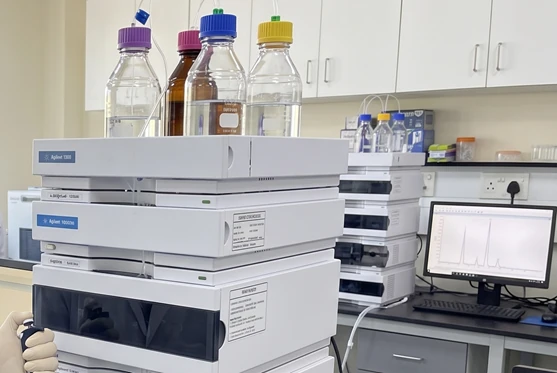
High-Performance Liquid Chromatography (HPLC) separates, identifies, and quantifies compounds within a mixture by passing a pressurized solvent through a column packed with a solid adsorbent material. In pharmaceutical quality control and analytical research, it's arguably the single most relied-upon technique, because it can measure both what should be in a formulation and what shouldn't.
Why HPLC Is Central to Pharma QC
A pharmaceutical product has to meet strict specifications — the active ingredient needs to be present at the correct concentration, and any impurities or degradation products need to stay below defined limits. HPLC handles both jobs in a single analytical run, separating the active compound from excipients, degradation products, and process impurities, then quantifying each peak against a reference standard.
Why It Matters in Research
High-Resolution Separation
HPLC resolves closely related small molecules with excellent precision, essential for purity and impurity analysis.
Accurate Quantification
Peak area correlates with compound concentration, enabling precise quantitative analysis against calibrated standards.
Detector Versatility
HPLC pairs with UV, PDA, fluorescence, or mass spectrometry detectors, adapting to a wide variety of analytes.
Reproducibility for Quality Control
Validated HPLC methods provide the reproducibility required for regulatory submissions and pharmaceutical release testing.
Wide-Ranging Applications
HPLC is used across pharmaceutical, food science, environmental, and biochemical research for compound identification and quantification.
Core QC Applications
- Assay/potency testing — confirming the active pharmaceutical ingredient (API) is present at the labeled concentration
- Impurity profiling — detecting and quantifying related substances, degradation products, or synthesis by-products
- Content uniformity — verifying consistent API distribution across tablets or capsules in a batch
- Stability testing — monitoring how a formulation degrades over time under different storage conditions
- Dissolution testing — measuring how quickly and completely a drug releases from its dosage form
HPLC vs. UPLC
| Feature | HPLC | UPLC |
|---|---|---|
| Particle Size | 3–5 µm | Sub-2 µm |
| Operating Pressure | Up to ~400 bar | Up to ~1000+ bar |
| Run Time | Longer | Significantly shorter |
| Solvent Consumption | Higher | Lower |
What Makes an HPLC Method Reliable
- Specific enough to separate the analyte from everything else in the mixture
- Sensitive enough to detect impurities at very low levels
- Reproducible across different runs, operators, and instruments
- Formally validated for specificity, linearity, accuracy, precision, and robustness before release testing use
Common Detector Choices
- UV detectors remain the most widely used for routine QC, since most pharmaceutical compounds absorb UV light
- PDA (photodiode array) detectors are increasingly common, capturing a full spectrum at every point in the run
- Mass spectrometry detectors (LC-MS) add structural confirmation for impurity identification
- Fluorescence detectors offer added sensitivity for specific compound classes
Frequently Asked Questions
What is the difference between HPLC and GC?
HPLC separates compounds dissolved in a liquid mobile phase and suits non-volatile or thermally unstable compounds, while GC (Gas Chromatography) separates volatile compounds in a gas phase.
What detectors are commonly used with HPLC?
Common HPLC detectors include UV-Vis, photodiode array (PDA), fluorescence, refractive index, and mass spectrometry (LC-MS).
How is HPLC different from UPLC?
UPLC uses smaller particle-size columns and higher pressures than HPLC, resulting in faster run times, higher resolution, and lower solvent consumption.
What are common applications of HPLC?
HPLC is widely used for pharmaceutical quality control, drug stability testing, metabolite profiling, and environmental and food safety analysis.
Conclusion
That reliability is why regulatory agencies require HPLC methods to go through formal validation before they can be used for release testing. Our HPLC analysis and diagnostics services cover method development, validation, and routine QC testing for pharmaceutical and clinical samples.