
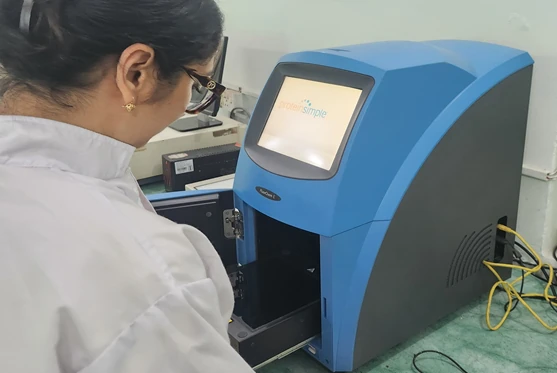
Protein isolation, SDS-PAGE, antibody-based detection — this Western Blot workshop covers the complete technique end to end, not just the theory slides. Over 12 hours, you'll run a real sample from lysate to a detected, visualized protein band.
What You'll Actually Do at the Bench
Protein Isolation and Quantification
You'll isolate protein from your sample and quantify it — the foundation step that determines how much sample you load and whether your final blot is readable.
SDS-PAGE
You'll run SDS-PAGE on your protein sample, separating proteins by molecular weight before transfer — the step most people have seen in textbooks but rarely run themselves.
Membrane Transfer
You'll perform membrane transfer using both semi-dry and wet blot methods, learning the practical differences between the two and when each is used.
Antibody Hybridization
You'll work through antibody hybridization — primary and secondary antibody incubation — the step that gives Western blot its specificity for a single target protein.
Protein Detection and Visualization
You'll finish by detecting and visualizing your protein band, connecting every earlier step to the final readout a Western blot is meant to produce.
Why Western Blot Skills Matter
Western blotting is widely used in molecular biology and biomedical research for the detection, identification, and quantification of specific proteins in a complex mixture. Its applications include:
- Disease diagnosis
- Protein expression analysis
- Detection of post-translational modifications
- Validation of antibodies
- Cancer and biomarker research
Western blotting remains a standard technique for protein expression analysis across research and diagnostic labs — which is why hands-on training in the full blotting workflow strengthens your candidacy for lab technician and research assistant roles.
Who This Workshop Is For
- Students in molecular biology, biochemistry, or life sciences wanting real bench time
- Job seekers targeting lab technician or research assistant roles
- Researchers who need practical grounding in antibody-based protein detection
- Professionals upskilling ahead of a diagnostics or biomarker-focused role
Workshop at a Glance
| Detail | What to Expect |
|---|---|
| Duration | 12 hours over a weekend (pre-registration required) |
| Format | Hands-on, bench-based, small group |
| Fee | INR 5,000 (Indian nationals) / $100 (foreign nationals) |
| You'll leave with | A completed blot, from protein isolation to visualized detection |
Frequently Asked Questions
How does Western Blot training benefit your career?
Western blotting is a standard technique for protein expression analysis across research and diagnostic labs. Hands-on training in the full blotting workflow strengthens your candidacy for lab technician and research assistant roles.
Which instruments and steps will I learn during the workshop?
You'll practice protein isolation and quantification, SDS-PAGE separation, semi-dry and wet membrane transfer, antibody hybridization, and final protein detection and visualization.
Why is the workshop fee fixed and non-negotiable?
The program utilizes advanced instrumentation, specialized chromatographic resins, and high-grade analytical reagents. Because the fee directly covers these extensive consumable costs and dedicated instrument time, the fee structure is fixed and non-negotiable.
How long is the workshop and what does it cost?
The workshop runs 12 hours over a weekend, with pre-registration required, for INR 5,000 (Indian nationals) or $100 (foreign nationals) per workshop.