
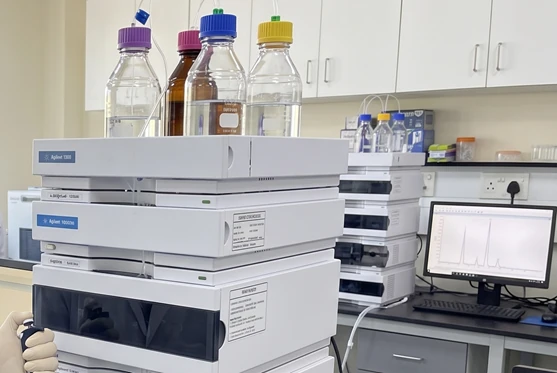
Amino acid analysis (AAA) quantifies individual free and protein-bound amino acids in a sample, reported as concentration against certified reference standards. It's used to confirm protein and peptide identity and purity, and to profile the nutritional amino acid content of food, feed, and cell culture media.
Total vs. Free Amino Acid Analysis
These two are easy to confuse but measure different things entirely. Total amino acid analysis quantifies amino acids that are chemically bound within protein and peptide structures — the sample has to be hydrolysed first to break those peptide bonds apart. Free amino acid analysis measures unbound, monomeric amino acids already present in a sample, such as physiological fluids, cell culture media, or extracts, and only requires deproteinization and filtration, no hydrolysis needed.
How the Analysis Works
Amino acids are identified and quantified by comparing retention times and peak areas against amino acid standard solutions. The most common method uses ion-exchange chromatography with post-column ninhydrin derivatization and spectrophotometric detection, though HPLC, GC-MS, and LC-MS/MS are also used depending on the sensitivity and specificity a sample requires.
Method Comparison
| Technique | Best Suited For | Key Advantage |
|---|---|---|
| Ion-Exchange Chromatography | Routine amino acid profile | High accuracy |
| HPLC | Food, pharma and research samples | Excellent sensitivity |
| GC-MS | Volatile amino acids | High resolution |
| LC-MS | Trace-level amino acids | High specificity |
What a Full Amino Acid Profile Covers
A complete profile spans five groups: acidic (aspartic acid, glutamic acid, asparagine, glutamine), basic (lysine, histidine, arginine), aliphatic/non-polar (alanine, glycine, valine, leucine, isoleucine, proline), sulfur-containing (cysteine, cystine, methionine), and aromatic/hydroxyl (threonine, serine, tyrosine, phenylalanine, tryptophan).
Where This Data Gets Used
- Biopharmaceuticals — confirming protein/peptide identity and purity
- Food, dairy and nutrition — nutritional labelling and composition verification
- Pet feed and agriculture — formulation and quality control
- Cell culture media — optimizing amino acid supplementation for cell growth
What a Standard Report Includes
- Absolute concentration (ppm, mg/ml, or gm/100gm)
- Calculated molar ratios and residue stoichiometry
- Estimated protein content with calculated extinction coefficients
- Multi-point calibration linearity metrics
- Annotated raw chromatograms
Frequently Asked Questions
What is amino acid analysis (AAA)?
Amino acid analysis is the quantification of individual free and protein-bound amino acids in a sample, reported as concentration against certified reference standards, used to confirm protein identity, purity, and nutritional composition.
What's the difference between total and free amino acid analysis?
Total amino acid analysis quantifies amino acids chemically bound within protein structures and requires hydrolysis first. Free amino acid analysis measures unbound amino acids already present in a sample and only requires deproteinization and filtration.
Which analytical platforms are used for amino acid analysis?
Ion-exchange chromatography with post-column ninhydrin derivatization is the classical method. Reversed-phase HPLC and GC-MS or LC-MS/MS are used for higher sensitivity or trace-level and volatile amino acid detection.
How many amino acids can be quantified in one analysis?
A full profile covers the standard protein amino acids across acidic, basic, aliphatic/non-polar, sulfur-containing, and aromatic/hydroxyl groups — typically the complete set of proteinogenic amino acids in a single run.