
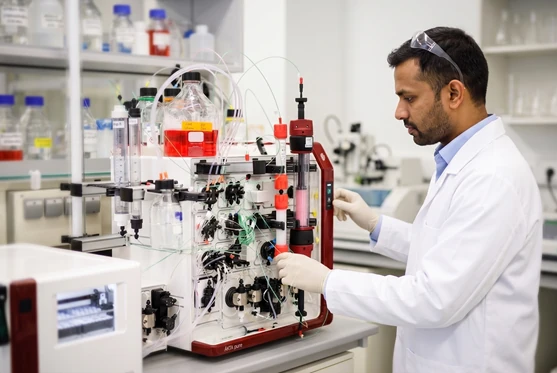
Antibody purification isolates antibodies from a complex mixture — serum, cell culture supernatant, or ascites fluid — into a clean, concentrated, functional antibody ready for research, diagnostic, or therapeutic use. The method you choose (Protein A, G, or L, or antigen-specific affinity) depends almost entirely on the antibody class and what you need it to do downstream.
The Standard Purification Workflow
A typical purification uses affinity chromatography for initial capture, ion-exchange or hydrophobic interaction chromatography to remove intermediate impurities, and size-exclusion chromatography for final aggregate polishing. Each stage removes a different category of contaminant, which is why skipping a stage usually shows up later as background noise or batch-to-batch variability in downstream assays.
Choosing a Capture Method
Protein A
Binds most IgG subclasses with high affinity and is the standard first choice for monoclonal IgG purification.
Protein G
Offers broader species and subclass coverage, including antibodies that bind Protein A weakly.
Protein L
Binds via the kappa light chain, making it useful for Fab fragments, scFv, and antibodies that don't bind Protein A or G well.
Antigen-Specific Affinity
Used when higher specificity is required than a generic Fc-binding resin can offer, particularly for polyclonal antibody purification from complex serum.
Why Purity Matters
Antibody purification removes host cell contaminants, proteases, and endotoxins that would otherwise cause assay background, cross-reactivity, protein degradation, or in vivo toxicity. Quality control confirms identity, purity, potency, and safety using A280 for concentration, SDS-PAGE, SEC-HPLC for aggregate analysis, ELISA for target binding, and LAL assays to verify the absence of endotoxins.
Common Purification Problems
| Problem | Likely Cause |
|---|---|
| Antibody fails to bind ion-exchange resin | Excessively high salt concentration or pH mismatched to the antibody's isoelectric point |
| Low yield after Protein A capture | Antibody subclass binds Protein A weakly — Protein G or L may be a better fit |
| High aggregate content | Insufficient size-exclusion polishing, or antibody stressed during earlier steps |
| Residual endotoxin | Inadequate washing or a resin not suited to endotoxin removal |
Applications
- Research and development — antibody characterization and functional assays
- Diagnostics — antibodies used in ELISA, lateral flow, and immunoassay development
- Therapeutic development — early-stage purification for candidate antibody screening
Frequently Asked Questions
What is antibody purification?
Antibody purification is the process of isolating antibodies from a complex mixture, such as serum, cell culture supernatant, or ascites fluid, to obtain a clean, concentrated, functional antibody for research, diagnostic, or therapeutic use.
Which purification method is best: Protein A, Protein G, or Protein L?
Protein A binds most IgG subclasses with high affinity and is the standard choice for monoclonal IgG. Protein G offers broader species and subclass coverage. Protein L binds via the kappa light chain, making it useful for Fab fragments and scFv.
Why does an antibody fail to bind to ion-exchange resin?
Usually excessively high salt concentration, an inappropriate pH relative to the antibody's isoelectric point, or interfering buffer components. Column efficiency can often be improved by optimizing buffer conditions and sample loading.
What quality control is performed on a purified antibody?
QC confirms identity, purity, potency, and safety using A280 for concentration, SDS-PAGE, SEC-HPLC for aggregate analysis, ELISA for target binding, and LAL assays to verify the absence of endotoxins.