
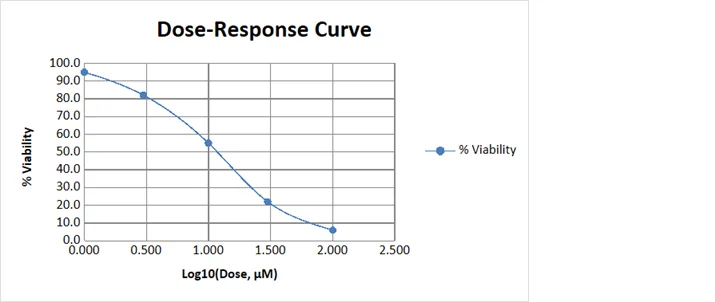
A cytotoxicity assay is a laboratory test used to determine toxicity in a drug, pharmaceutical product, cosmetic, or medical device, by measuring its effect on cell viability. These assays are central to drug development, cancer research, and toxicology, wherever a compound needs to be screened for whether it damages living cells.
Common Cytotoxicity Assay Types
| Assay | What It Measures |
|---|---|
| MTT Assay | Metabolic activity as a proxy for cell viability |
| LDH Assay (Lactate Dehydrogenase Release) | Membrane damage, via enzyme leakage from dying cells |
| Trypan Blue Exclusion Assay | Direct live/dead cell counting under the microscope |
| Resazurin (Alamar Blue) Assay | Metabolic activity via a fluorescent readout |
| Annexin V / Propidium Iodide Staining | Distinguishes live, early apoptotic, and dead cells by flow cytometry |
| Caspase Activity Assays | Activation of the enzymes that drive programmed cell death |
Testing Materials and Medical Devices
The biocompatibility and toxicity of materials used in pharmaceuticals, medical devices, and related products is assessed using mammalian tissue culture methods. Several standardized tests exist specifically for characterizing the toxicity of medical device components: MEM elution assay, agar overlay cytotoxicity assay, agar diffusion test, XTT/MTT staining, and neutral red uptake (NRU) staining.
Choosing an Assay Format
- Flow cytometry-based assays (e.g., Annexin V/PI staining) — for detailed, single-cell resolution of viability states
- LDH release assays — for a fast, plate-based readout of membrane damage
- Fluorescent assays (e.g., Alamar Blue) — for high-throughput metabolic activity screening
- Microscopic assessment — for direct visual confirmation alongside quantitative data
Why This Testing Matters
These services provide essential support for research, drug development, and toxicity screening across biomedical applications. Outsourcing cytotoxicity testing gives organizations access to specialized technical expertise, state-of-the-art facilities, and standardized protocols that are difficult to replicate in-house at the same scale or consistency.
Frequently Asked Questions
What is a cytotoxicity assay?
A cytotoxicity assay is a laboratory test used to determine toxicity in a drug, pharmaceutical product, cosmetic, or medical device by measuring its effect on cell viability, widely used in drug development, cancer research, and toxicology.
What's the difference between MTT and LDH assays?
The MTT assay measures metabolic activity as a proxy for cell viability, while the LDH assay measures membrane damage by detecting enzyme leakage from dying cells — they capture different signals of cell stress.
Which cytotoxicity tests are used for medical devices?
Standardized tests for medical device components include the MEM elution assay, agar overlay cytotoxicity assay, agar diffusion test, XTT/MTT staining, and neutral red uptake (NRU) staining.
Why use flow cytometry for cytotoxicity testing?
Flow cytometry-based assays, such as Annexin V/PI staining, give single-cell resolution, distinguishing live, early apoptotic, and dead cells rather than just a bulk population average.