
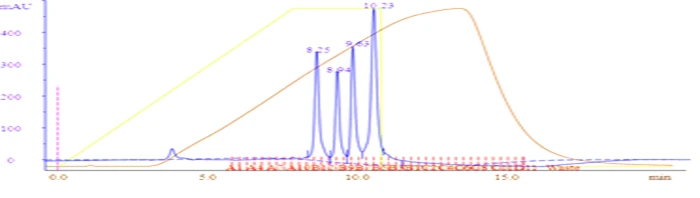
Size exclusion chromatography (SEC) is the one chromatography mode where nothing binds. Molecules are sorted purely by how much of a porous bead's interior they can enter: large species are excluded and travel with the mobile phase, while small ones diffuse into the pores and lag behind. Everything elutes within one column volume, in strict order of decreasing hydrodynamic radius — which is why it is the standard final polishing step and the standard test for aggregation and oligomeric state.
The Volumes That Define a Column
A SEC column has a fixed internal geometry, and every retention volume falls between two limits: the void volume (the space between the beads, where aggregates and large complexes elute) and the total volume (everything accessible to solvent, where salts and small buffer components elute). Separation happens only in the difference between these two — which is why resolution is finite and why the injected load volume has to stay small.
Matching Resin to Purpose
| Resin Class | Typical Range | Use |
|---|---|---|
| High resolution, small bead | 10–600 kDa | Analytical sizing, oligomer resolution |
| Wide range, preparative | 10–600 kDa | Standard polishing step |
| Large pore | Up to 10⁶ Da | Complexes, VLPs, viral particles |
| Desalting / group separation | > 5 kDa excluded | Buffer exchange, salt removal |
A protein eluting at either the void or the total volume limit carries no real size information — the resin's separation range should bracket the expected size of the target.
The Running Buffer Is the Final Buffer
SEC is isocratic, so whatever the column runs in is exactly what the protein ends up in — this makes the step a convenient way to deliver a final storage or assay buffer directly. Including 100–150 mM salt matters: at low ionic strength, residual charge on the resin matrix causes a weak ion-exchange effect, and proteins elute later or earlier than their size alone would predict.
Load Volume Is the Resolution Knob
Peak width is set by the injected band plus diffusion, and there is no gradient available to re-concentrate anything after the fact. A 2% column-volume load resolves species that a 10% load would merge together. The right response to poor resolution is to concentrate the sample before injection rather than injecting a larger volume — though not to the point of aggregation, which the column will faithfully report back.
| Application | Typical Load |
|---|---|
| Analytical sizing | 0.5–1% CV |
| Preparative polishing | 2–5% CV |
| Desalting | Up to 30% CV |
How Do You Read a Size Exclusion Chromatogram?
| Feature | Interpretation |
|---|---|
| Peak at the void | Soluble aggregate or a complex above the resin's range |
| Two peaks, 2:1 volume ratio | Dimer and monomer — confirm against standards or light scattering |
| Tailing peak | Non-specific interaction with the matrix — raise salt, or check pH |
Pooling and the Dilution Problem
SEC always dilutes the sample, typically two- to five-fold, and pooling broadly to recover yield can reintroduce exactly the shoulder species the step was meant to remove. The standard approach is to take the peak apex narrowly, keep any shoulders as separate fractions, and concentrate afterwards while watching for aggregation that the next SEC run would reveal.
Frequently Asked Questions
Can SEC tell me the exact molecular weight of my protein?
Only an apparent mass, and only for globular proteins. SEC measures hydrodynamic radius, so elongated, glycosylated, or intrinsically disordered proteins run larger than their sequence mass predicts. For a definitive number, pair the column with light scattering (SEC-MALS).
Why is my main peak tailing?
Tailing usually indicates a non-specific interaction between the protein and the resin matrix — raising the salt concentration in the running buffer or adjusting pH often resolves it.
Conclusion
Reliable SEC results come down to matching resin range to your target, keeping the load small, and pooling narrowly rather than broadly. Our protein purification and analysis services include SEC-based polishing and aggregate characterization.