
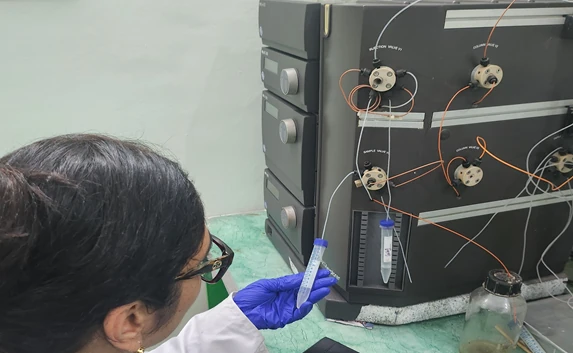
Affinity chromatography is the only chromatography mode that separates by molecular recognition rather than a bulk physical property. An immobilized ligand binds the target protein specifically while everything else washes through, so a single step can take a crude cell lysate to greater than 90% purity — because the separation is defined by the biology of one interaction rather than a gradient.
Choosing the System
Every affinity system is really a pair of decisions: what holds the target, and what releases it. The release chemistry matters more than the capture chemistry, because it is what the purified protein actually has to survive.
| System | Binds | Eluted By |
|---|---|---|
| IMAC | His-tag → Ni²⁺/Co²⁺ | Imidazole gradient, or low pH |
| Protein A / G | IgG Fc region | pH 3–3.5 glycine or citrate |
| GST | GST tag → glutathione | 10–20 mM reduced glutathione |
| Strep / MBP | Strep-tag, MBP | Biotin analogue; maltose |
Competitive elution — imidazole, glutathione, maltose — is gentle on the protein. pH elution is harsh, and fractions should be neutralized into Tris the moment they land in the collection tube.
Capacity Is the Constraint, Not Volume
Unlike ion exchange, an affinity column has a finite number of ligand sites and no gradient to sharpen the result. Once those sites saturate, the target simply flows through unbound — so the load is calculated against stated capacity (roughly 40 mg/mL resin for IMAC, 30–50 mg IgG/mL for Protein A), typically targeting 50–70% of capacity with a residence time of 2–4 minutes.
Running the Method
Nearly every affinity method follows the same five blocks: equilibrate (5 CV), load slowly while collecting the flow-through, wash 10–20 CV to a flat UV baseline, elute by step or short gradient, and regenerate. The wash is where purity is won — stopping early carries every weakly-bound contaminant straight into the elution peak, and no downstream step recovers that loss.
Step vs. Gradient Elution
A step elution gives a small, concentrated peak and is the right default for a tagged protein — 2–3 CV at full eluent strength, fast and robust. A short gradient (10–20 CV) trades concentration for information, resolving contaminants that share the ligand weakly and giving a reproducible elution point worth recording for future runs.
Affinity Is a Capture Step, Not a Purification
One affinity step removes most host cell protein but leaves behind what the ligand cannot see: aggregates and oligomers of the target itself, cleaved tag, leached ligand, nucleic acid, and endotoxin. A capture-then-polish sequence is the norm — affinity to concentrate and clean, followed by size exclusion or ion exchange to resolve the species the ligand treats identically.
How Do You Diagnose a Failed Affinity Run?
| Observation | Likely Cause |
|---|---|
| Target in flow-through | Capacity exceeded, tag inaccessible, or load flowed too fast |
| No elution peak at all | Binding too tight for the eluent, or the protein precipitated on the bed |
| Many bands in the peak | Wash too short, or genuine co-purifying complex partners |
| Smear below the target | Proteolysis — add inhibitors and shorten time at room temperature |
Frequently Asked Questions
Why does my His-tagged protein come out in the flow-through?
The most common causes are a buried tag on a folded terminus, a chelator such as EDTA in the buffer stripping the metal, or loading the sample too fast for the resin to bind it.
Do I need to polish after an affinity step?
Almost always. A single affinity capture is typically over 90% pure by SDS-PAGE, but it cannot distinguish aggregates, cleaved tag, or nucleic acid from the intact target — a size exclusion or ion exchange polish step is standard practice.
Conclusion
Reliable affinity purification comes down to matching ligand and elution chemistry to your tag, respecting capacity limits, and washing to a genuinely flat baseline before elution. Our protein purification services cover method development, scale-up, and full analytical characterization of the purified pool.