
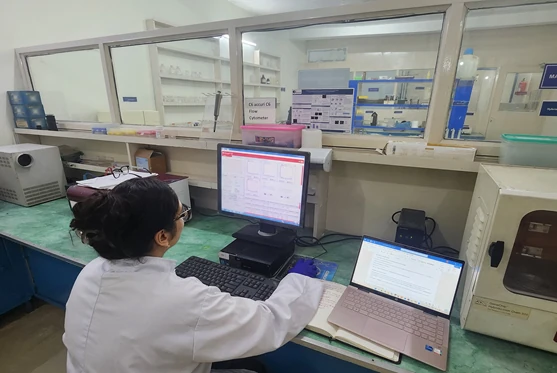
A volumetric flow cytometer uses a peristaltic pump to draw a precisely measured volume of sample, rather than a pressure-driven stream — so the instrument knows exactly how much sample produced a given number of events. Concentration becomes a direct readout of events divided by volume, with no counting beads, no dilution-factor arithmetic, and none of the operator variance that comes with a haemocytometer.
Why Does Volumetric Counting Work?
Every event written to the data file carries a timestamp, and the pump delivers a known volume per unit time. The software divides gated events by the volume acquired, so a count is reported per gate — total cells, live cells, or a specific labelled subset — from the very same acquisition.
| Method | How It Works | Main Limitation |
|---|---|---|
| Volumetric | Pump displacement defines the volume directly | None to calibrate per run |
| Bead-based | Reference beads of known concentration are spiked in | Accuracy limited by spike pipetting and bead lot titre |
| Haemocytometer | A few hundred cells counted by eye | 15–30% operator CV, no marker discrimination |
What It's Good For
- Proliferation and growth curves: absolute counts over time, not just a normalized ratio
- Cytotoxicity assays: distinguishes cells that were killed and lost from cells that were merely arrested — a percentage cannot
- Seeding and normalization: accurate input numbers for transfection, plating, and MOI calculations
- Subset enumeration: cells per µL of a marker-defined population, gated rather than assumed
Setting Up a Reliable Count
Cells settle within minutes, so every tube is inverted immediately before the port, and every well of a plate experiment is harvested completely — including the medium — or the denominator shifts between conditions. For counting runs, the instrument is set to stop on a fixed volume rather than a fixed event count, so every tube gets the same denominator instead of running until it finds enough events.
Concentration Limits Both Ways
Too dense, and two cells cross the beam together, counted as a single event — a systematic undercount that worsens as concentration rises. Too dilute, and Poisson statistical noise dominates, so replicates scatter for purely statistical reasons. The target is generally under 2,500 events per second with at least 1,000 events inside the counting gate.
Precision Has a Statistical Floor
Counting error has a hard statistical floor: with n events in the gate, the coefficient of variation cannot beat 1/√n regardless of instrument quality.
| Events in Gate | Expected CV |
|---|---|
| 100 | ± 10% |
| 1,000 | ± 3.2% |
| 10,000 | ± 1% |
Frequently Asked Questions
Why do my counts read low for later tubes in a plate series?
Cells sediment during a long plate run. Invert every tube immediately at the port to keep the count representative of the whole sample.
How do I get a live-cell count instead of a total count?
Add a membrane-exclusion viability dye such as PI or 7-AAD directly to the tube — one acquisition then reports total, live, and dead counts with no extra wash step.
Conclusion
Accurate absolute cell counts depend on proper sample handling, a volume-limited acquisition, and a gate that is drawn once and applied consistently across a series. Our flow cytometry services and workshops cover counting, viability, and full immunophenotyping applications.