
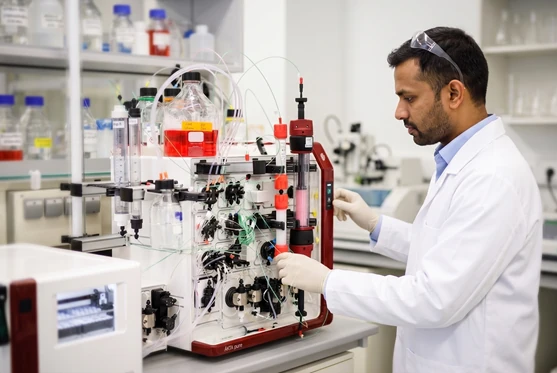
FPLC (Fast Protein Liquid Chromatography) combines a pump, a column, a detector, and a fraction collector under one programmed method. What separates it from a manual gravity column is not speed but control — flow, gradient, and collection are all defined in advance and recorded as they happen, turning protein purification into a reproducible measurement rather than a manual procedure.
The Instrument: Flow Path in Order
Sample and buffer move through the system as: buffers A and B → pump and mixer → injection valve → column → detectors → fraction collector. Two buffer inlets are proportioned in real time to produce any gradient from a single pair of buffers; a noisy conductivity trace usually points to air in the system or a failing mixer rather than a problem with the method itself. UV absorbance (280 nm for protein, 260 nm for nucleic acid), conductivity, pH, and pressure are read together — never in isolation — to interpret a run.
Vocabulary That Runs the Method
| Term | Meaning |
|---|---|
| CV | Column volume — the unit every method step is written in, so a method scales unchanged between column sizes |
| %B | Fraction of the second buffer; a gradient is a programmed %B ramp over a stated number of CV |
| Residence time | CV divided by flow rate — how long sample spends in contact with the resin |
| CIP | Clean-in-place — a caustic or salt wash that removes what a simple strip did not |
Four Separation Modes, One System
| Mode | Separates By | Character |
|---|---|---|
| Affinity | Specific binding | Highest selectivity, finite capacity — the capture step of choice |
| Ion exchange | Net surface charge | High capacity and resolution, unlimited load volume, cheap |
| Size exclusion | Hydrodynamic radius | Nothing binds; the standard polish and aggregate check |
| Hydrophobic interaction (HIC) | Surface hydrophobicity | Binds at high salt, elutes as salt falls — pairs naturally after IEX |
Ordering the Steps
A good purification sequence never runs two steps that sort on the same physical property, and it puts the concentrating steps first. A typical order captures from crude lysate on a high-capacity or highly selective column, purifies further on a mode that sees a different property, and polishes last on size exclusion — which cannot concentrate the sample, so it must come after volume is already small.
Before You Press Start
Most failed runs are effectively lost before the sample is even injected. The checklist that prevents this: buffers filtered (0.22 µm) and degassed, system lines purged of air and any residual salt from the previous run, the sample clarified and on ice, the column equilibrated until both UV and conductivity are flat, and the pressure alarm set safely below the column's rating.
How Do You Read FPLC Traces Together?
| Observation | Interpretation |
|---|---|
| Noisy, spiking UV | Air bubbles — degas buffers and purge the flow path |
| Rising back-pressure | Particulates or precipitate on the bed — stop, do not push through |
| Asymmetric, tailing peaks | Overload, void at the bed top, or non-specific interaction |
Frequently Asked Questions
Why should a method be written in column volumes rather than millilitres?
A method written in CV transfers unchanged between a small screening column and a large preparative one. A method written in mL has to be recalculated for every column size, which introduces errors.
What's the single most common cause of pressure faults?
Unfiltered buffer or sample is the most common cause of pressure faults and, over time, permanent bed damage.
Conclusion
A well-run FPLC purification comes down to method discipline — steps written in CV, buffers filtered and degassed, and traces read together rather than in isolation. Our protein purification services and FPLC workshop cover method development from scouting through to process-scale runs.