
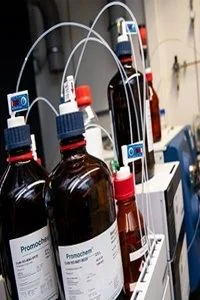
Gas Chromatography (GC) separates and analyzes compounds that can be vaporized without decomposing, making it the method of choice whenever a quality control lab needs to characterize volatile or semi-volatile substances. A sample is vaporized and carried through a column by an inert gas, and different compounds separate based on how strongly they interact with the column's stationary phase.
Where Does GC Fit Into Quality Control?
Anywhere a product's volatile composition matters — pharmaceuticals, food and beverage, fragrances, petrochemicals, or environmental samples — GC is typically part of the QC toolkit. It's especially well suited to detecting trace-level volatile impurities that other techniques might miss.
Core applications
- Residual solvent testing — pharmaceutical manufacturing requires strict limits on leftover solvents from synthesis, and GC is the standard method for measuring them
- Purity and identity testing — confirming a raw material or finished product matches its expected composition
- Flavor and fragrance analysis — characterizing the volatile compounds responsible for scent and taste profiles
- Environmental testing — detecting volatile organic compounds (VOCs) in water, soil, or air samples
- Petrochemical analysis — profiling hydrocarbon composition in fuels and related products
Detector choice matters
Different detectors suit different jobs — a Flame Ionization Detector (FID) is a reliable general-purpose choice for most organic compounds, while GC-MS pairs the separation power of GC with mass spectrometry for definitive compound identification, which is invaluable when confirming an unknown peak or investigating an unexpected impurity.
Running a dependable GC method
A typical QC workflow starts with system suitability checks to confirm the instrument is performing within spec, followed by standard and sample preparation, an optimized temperature program for the column oven, and finally a full sample run with data compared against reference standards. Getting consistent, defensible results depends on tight control over injection technique, carrier gas flow, and column condition — small inconsistencies here show up directly as retention time drift or peak shape problems.
Our GC and GC-MS analysis services and hands-on workshop cover the complete method, from sample preparation through data interpretation.
Frequently Asked Questions
What's the difference between using an FID and a GC-MS detector?
A Flame Ionization Detector (FID) is a reliable general-purpose choice for most organic compounds, while GC-MS pairs GC's separation power with mass spectrometry for definitive compound identification -- useful when confirming an unknown peak or investigating an unexpected impurity.
Why is GC the standard method for residual solvent testing in pharma?
Pharmaceutical manufacturing requires strict limits on leftover solvents from synthesis, and GC is the standard method used to measure them accurately at trace levels.