
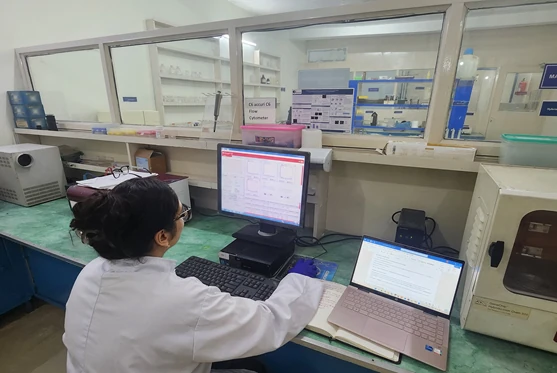
Our Flow Cytometry workshop gets you operating a flow cytometer directly — instrument set-up, quality control, experimental design, and multi-color immunophenotyping — across 20 hours of hands-on training, not lecture slides.
What You'll Actually Do at the Bench
Principles and Application
You'll start with the principles of flow cytometry and how the instrument measures physical and chemical characteristics of cells as they pass through a laser beam in a fluid stream.
Instrument Set-Up
You'll get an overview of the instrument and work through set-up yourself, building the operational fluency that separates someone who's read about flow cytometry from someone who can actually run it.
Quality Control and Experimental Design
You'll learn how to design an experiment and apply the quality control steps that keep multi-parameter data trustworthy — the same rigor expected in a research or clinical lab.
Cell Cycle and Apoptosis Analysis
You'll run cell cycle analysis and apoptosis analysis, two of the most common applications of flow cytometry in immunology, oncology, and cell biology research.
Data Analysis and Presentation
You'll finish by analyzing your own run data and learning how to present it clearly — the step that turns a raw dataset into something a lab or client can actually use.
Why Flow Cytometry Skills Matter
Flow cytometry is a powerful tool for analyzing multiple parameters on an individual cell basis. A flow cytometer detects and identifies cell types, performs cell counting, apoptosis assays, and biomarker and immune response analysis — all of which are core skills across immunology, oncology, and cell biology research. Practical grounding in multiparameter cell analysis is exactly what research assistant and lab technician roles in these fields look for.
Who This Workshop Is For
- Students in immunology, cell biology, or biotechnology wanting hands-on instrument time
- Job seekers targeting research assistant or lab technician roles involving cell analysis
- Researchers who need practical grounding in gating strategy and experimental design
- Professionals upskilling in multi-color panel design and interpretation
Workshop at a Glance
| Detail | What to Expect |
|---|---|
| Duration | 20 hours, up to 5 days (weekend batches available) |
| Format | Hands-on, instrument-based, small group |
| Fee | INR 6,000 per workshop (Indian nationals) |
| You'll leave with | Practical flow cytometer operation and your own analyzed dataset |
Frequently Asked Questions
How does Flow Cytometry training help your career?
Flow cytometry skills are in demand across immunology, oncology, and cell biology research. This workshop gives you the practical grounding needed for research assistant and lab technician roles that involve multiparameter cell analysis.
Which instruments will I use during the workshop?
You'll operate a flow cytometer directly, covering instrument set-up, quality control, and experimental design for cell cycle and apoptosis analysis, along with data analysis and presentation.
Do I need prior cytometry experience?
No. The workshop starts with the principles of flow cytometry and instrument set-up before moving into experimental design and data analysis, so it's suitable even without prior hands-on cytometry experience.
How long is the workshop and what does it cost?
The workshop runs 20 hours, spread across up to 5 days with weekend batches available, for INR 6,000 per workshop for Indian nationals.