
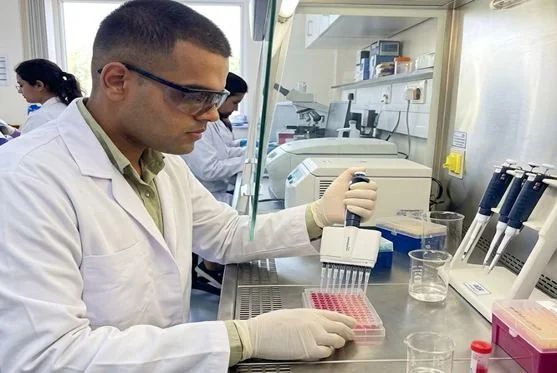
Real-time PCR or quantitative PCR or qPCR is a lab method used to copy and measure the amount of a target DNA or RNA molecule in a sample. It was a remarkable discovery by Russel Higuchi that PCR can be monitored by using fluorescent probes. Real Time PCR techniques and their applications have transformed life science research and clinical diagnosis.
What is the difference between RT-PCR, qPCR and RT-qPCR?
1. PCR and RT-PCR are typically endpoint reactions, while
qPCR and RT-qPCR use the kinetics of the rate of product synthesis during the
PCR
reaction to quantitate the amount of template present.
2. Reverse
transcription PCR, or RT-PCR, allows the use of RNA as a template. An additional
step allows the detection and amplification of
RNA by conventional PCR.
3. Q-PCR or quantitative PCR, which means that each cycle in the PCR process has
a real-time record of data, so the number of starting
templates can be
determined by Ct or Cq values.
4. RT-qPCR means quantitative analysis of cDNA
(processed by reverse transcription)
How samples are prepared for Q-PCR Analysis?
A- Isolation of RNA with RNA Extraction Kit or TRIzol
method.
B- Convert RNA to cDNA in process reverse transcription this need
kit with certain primer and PCR machine.
C- Real time pcr using specific
primer for your target genes and another for your housekeeping gene + prob
or Syber green + Real time pcr
machine
D. the result will be on
computer its the values of Ct and by certain equation you can calculate.
What is the difference between absolute and Relative quantification?
In real-time PCR (qPCR), absolute quantification
determines the exact number of nucleic acid copy numbers or concentration
per unit volume, whereas relative quantification measures the fold-change or
relative ratio of a target gene compared to a reference or control sample.
Absolute Quantification: Standard curve method (Ct vs.
log(copy number)).
Relative Quantification: Requires a
reference or housekeeping gene and a control sample (untreated control).It
is a Comparative Ct method.
Why It Matters in Research
Quantitative Precision
qPCR measures gene expression or nucleic acid concentration across a wide dynamic range, from single copies to billions of molecules, with high accuracy.
Speed and High Throughput
Amplification and detection happen in the same closed tube, with no need for post-PCR gel electrophoresis, enabling rapid results in 96- or 384-well formats.
High Sensitivity and Specificity
Probe-based chemistries like TaqMan offer excellent target specificity, while the exponential nature of PCR allows detection of very low copy-number targets.
Broad Application Range
qPCR supports gene expression profiling, SNP genotyping, viral load testing, and copy number variation analysis.
Reduced Contamination Risk
The closed-tube format eliminates the need to open tubes for post-amplification handling, lowering the risk of carryover contamination.
Where Real-Time PCR Gets Used
- Gene expression analysis — comparing how much a specific gene is transcribed under different conditions or treatments
- Infectious disease diagnostics — detecting and quantifying viral or bacterial load from a clinical sample
- Genetic screening — identifying mutations, SNPs, or copy number variations
- Pathogen and contamination testing — confirming the presence or absence of specific organisms in food, water, or pharmaceutical samples
- Validating NGS or microarray findings — qPCR is often used as an orthogonal method to confirm results from larger-scale genomic screens
Real-Time PCR vs. Conventional PCR
| Feature | Real-Time PCR (qPCR) | Conventional PCR |
|---|---|---|
| Detection | Real-time, fluorescence-based | End-point, gel electrophoresis |
| Quantification | Quantitative (Ct-based) | Qualitative or semi-quantitative |
| Contamination Risk | Low (closed-tube) | Higher (post-PCR handling) |
| Sensitivity | Very high, wide dynamic range | Moderate |
Practical Considerations for Reliable Results
- Design primers with high specificity and minimal secondary structure
- Select a stable reference/housekeeping gene and include no-template controls
- Optimize annealing temperature and primer concentration for efficient amplification
- Validate assay efficiency using a standard curve (ideally 90–110% efficiency)
- Run technical replicates to ensure reproducibility of Ct values
Why Quantification Matters
- Supports rigorous experimental design with numeric, statistically comparable results rather than a simple gel band
- Enables tracking of fold-changes in gene expression over a time course
- Allows defensible thresholds for diagnostic calls in clinical and food-safety testing
- Provides an objective, reproducible readout across large sample sets
Frequently Asked Questions
What is a Ct value?
The Ct (cycle threshold) value is the PCR cycle number at which fluorescence signal crosses a set threshold, and it is inversely proportional to the initial amount of target nucleic acid.
What is RT-qPCR?
RT-qPCR combines reverse transcription of RNA into cDNA with quantitative PCR, allowing researchers to quantify gene expression directly from RNA samples.
Why is Real-Time PCR preferred over conventional PCR?
It provides quantitative, real-time data in a closed-tube format, removing the need for post-PCR gel electrophoresis and reducing contamination risk while improving sensitivity.
Where is Real-Time PCR commonly used in diagnostics?
It is widely used in infectious disease testing, including detection of viral pathogens, due to its speed, sensitivity, and quantitative output.
Conclusion
Getting reliable Ct values depends on good primer design, appropriate reference gene selection, and careful reaction setup — small pipetting errors or primer-dimer formation can meaningfully shift results. Our lab runs Real-Time PCR services and hands-on training covering exactly this workflow, from sample prep to data interpretation.