
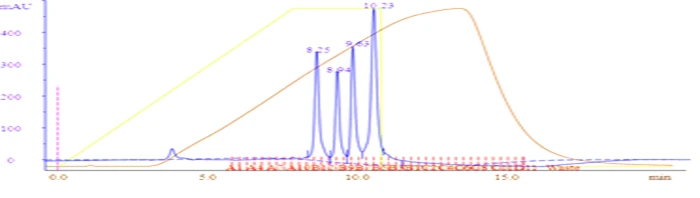
FPLC vs HPLC is one of the most common questions in protein science. Both are liquid chromatography techniques, but they are built for different jobs. In short: FPLC is the workhorse for purifying recombinant proteins in their native, active form, while HPLC is the gold standard for high-resolution analysis of protein purity, identity and quality.
This guide explains how the two methods differ, when to use each, and how they work together in a complete recombinant protein purification workflow.
What Is FPLC?
Fast protein liquid chromatography (FPLC) is a low-to-medium pressure chromatography system designed specifically for proteins. It uses biocompatible, metal-free flow paths (such as PEEK and glass), aqueous buffers and larger resin beads, so proteins stay folded and biologically active. Systems such as the ÄKTA range are standard in protein purification labs.
FPLC supports all the main protein chromatography modes:
- Affinity chromatography: His-tag purification on Ni-NTA (IMAC), GST-tag on glutathione resin, and Protein A or G for antibodies.
- Ion exchange chromatography (IEX): Separates proteins by surface charge using anion or cation exchangers.
- Size exclusion chromatography (SEC): Separates by molecular size and removes aggregates; also called gel filtration.
- Hydrophobic interaction chromatography (HIC): Separates by surface hydrophobicity under gentle, non-denaturing conditions.
What Is HPLC?
High-performance liquid chromatography (HPLC) runs at much higher pressures using very small particles, typically a few micrometres in size. This gives sharp peaks and excellent resolution, making HPLC ideal for analysing protein samples. Reversed-phase HPLC (RP-HPLC), the most common mode, uses organic solvents such as acetonitrile with trifluoroacetic acid, which often denature proteins.
In recombinant protein work, HPLC is mainly used for:
- Purity analysis: RP-HPLC to quantify purity and detect impurities.
- Aggregate analysis: SEC-HPLC to measure monomer, dimer and high-molecular-weight aggregates.
- Charge variant analysis: IEX-HPLC to detect deamidation and other modifications.
- Identity confirmation: LC-MS for intact mass and peptide mapping.
- Preparative purification of peptides and small, robust proteins that tolerate organic solvents, such as insulin.
FPLC vs HPLC: Key Differences
- Purpose: FPLC is built for preparative protein purification; HPLC is primarily an analytical tool.
- Pressure: FPLC runs at low to medium pressure; HPLC runs at high pressure, and UHPLC higher still.
- Resin particle size: FPLC uses larger beads that allow high flow with low back-pressure; HPLC uses small particles for maximum resolution.
- Buffers: FPLC uses mild aqueous buffers that keep proteins native; RP-HPLC often uses organic solvents that can denature them.
- Biological activity: FPLC preserves protein structure and function; HPLC samples may lose activity, depending on the mode.
- Scale: FPLC handles micrograms to grams of protein; HPLC typically handles micrograms to milligrams.
- Resolution: HPLC delivers higher resolution, ideal for detecting small impurities and variants.
- Flow path: FPLC uses metal-free, bio-inert materials; standard HPLC often uses stainless steel, although bio-inert HPLC systems exist.
A Typical Recombinant Protein Purification Workflow
Most labs combine both techniques, using FPLC to purify and HPLC to confirm quality:
- Express the recombinant protein in E. coli, yeast, insect or mammalian cells.
- Lyse cells and clarify the lysate by centrifugation and filtration.
- Capture: affinity chromatography on FPLC (e.g., His-tag purification on Ni-NTA).
- Intermediate purification: ion exchange chromatography on FPLC to remove host cell proteins and DNA.
- Polishing: size exclusion chromatography on FPLC to remove aggregates and exchange buffer.
- Quality control: SDS-PAGE, then RP-HPLC and SEC-HPLC for purity and aggregation, and LC-MS for identity.
When to Choose FPLC
- You need active, correctly folded protein for enzyme assays, structural biology, cell studies or antibody production.
- You are purifying milligram to gram quantities.
- You use affinity tags such as His-tag, GST or Protein A.
- Your protein is large, fragile or sensitive to organic solvents.
When to Choose HPLC
- You need precise purity, aggregation or charge variant data.
- You are running QC or release testing on a purified protein.
- You are purifying peptides or small, stable proteins.
- You need LC-MS confirmation of protein identity.
Frequently Asked Questions
What is the main difference between FPLC and HPLC?
FPLC uses low pressure and mild buffers to purify proteins in their active form, while HPLC uses high pressure and small particles to analyse samples with high resolution.
Can HPLC be used for protein purification?
Yes, especially for peptides and small, robust proteins. For most large or fragile recombinant proteins, FPLC is preferred because it preserves activity.
Is FPLC a type of HPLC?
Both are forms of liquid chromatography, but FPLC is a separate, protein-focused technique that runs at lower pressure with biocompatible materials.
Which method is best for His-tag protein purification?
FPLC with an IMAC (Ni-NTA or cobalt) column is the standard choice for His-tag protein purification.
Conclusion
FPLC and HPLC are partners, not rivals. FPLC is the best choice for purifying recombinant proteins at scale while keeping them active, and HPLC is the best choice for proving their purity, identity and quality. Using FPLC for capture, intermediate and polishing steps, followed by HPLC-based quality control, gives a reliable, high-purity recombinant protein ready for research or development.