
Cell viability and cytotoxicity assays are among the most common tests in drug discovery, toxicology, herbal and nutraceutical research, and medical device testing. Three methods dominate: the MTT assay, the resazurin (alamarBlue) assay and the LDH release assay.
They are often treated as interchangeable, but they measure different things. MTT and resazurin measure the metabolic activity of living cells, while LDH measures damage to dying cells. Choosing the right assay, or the right combination, is key to accurate IC50 values and reliable conclusions.
MTT Assay: The Classic Viability Test
The MTT assay uses a yellow tetrazolium salt that metabolically active cells reduce to insoluble purple formazan crystals, mainly through NAD(P)H-dependent enzymes. The crystals are dissolved in DMSO or an SDS solution and absorbance is read at about 570 nm.
- Measures: Metabolic activity, used as an indicator of viable cell number.
- Strengths: Inexpensive, well established, widely published and easy to compare with literature. It is also referenced in ISO 10993-5 for medical device cytotoxicity testing.
- Limitations: End-point only, since MTT and the solubilisation step kill the cells. Requires an extra solubilisation step. Antioxidants, polyphenols and other reducing compounds can reduce MTT directly and give falsely high viability.
Water-soluble tetrazolium alternatives such as MTS, XTT and WST-8 (CCK-8) skip the solubilisation step.
Resazurin (alamarBlue) Assay: Sensitive and Non-Destructive
Resazurin is a blue, weakly fluorescent dye that living cells reduce to pink, highly fluorescent resorufin. The signal is read by fluorescence (excitation about 560 nm, emission about 590 nm) or by absorbance.
- Measures: Metabolic (reducing) activity of living cells.
- Strengths: More sensitive than MTT, no solubilisation step, and largely non-toxic over short incubations. Cells can be monitored over time or reused for other assays in the same well, making it ideal for high-throughput screening.
- Limitations: Long incubations or very dense cultures can over-reduce resorufin to a colourless product, lowering the signal. Reducing compounds and fluorescent test samples can interfere.
LDH Assay: Measuring Membrane Damage
Lactate dehydrogenase (LDH) is a stable enzyme that leaks into the culture medium when the cell membrane is damaged. The LDH release assay measures this enzyme in the supernatant using a coupled reaction that produces a red formazan, read at about 490 nm.
- Measures: Cytotoxicity, specifically loss of membrane integrity from necrosis or late apoptosis.
- Strengths: Uses only the supernatant, so cells remain available for other assays. Gives a direct measure of cell death rather than reduced metabolism.
- Limitations: Does not detect cytostatic effects, where cells stop growing but stay intact. Serum in the medium contains LDH and raises background. Compounds that inhibit LDH can mask toxicity.
LDH results are calculated as % cytotoxicity = (experimental − spontaneous release) / (maximum release − spontaneous release) × 100, using untreated cells for spontaneous release and fully lysed cells for maximum release.
MTT vs Resazurin vs LDH: Key Differences
- What is measured: MTT and resazurin measure metabolic activity of living cells; LDH measures membrane damage in dead or dying cells.
- Viability or cytotoxicity: MTT and resazurin are viability assays; LDH is a cytotoxicity assay.
- Cells after the assay: MTT kills the cells; resazurin leaves them largely intact; LDH samples only the medium.
- Sensitivity: Resazurin is generally the most sensitive; MTT is moderate; LDH depends on how many cells die.
- Workflow: Resazurin and LDH are add-and-read; MTT needs a solubilisation step.
- Detection: MTT and LDH use absorbance; resazurin is best read by fluorescence.
- Main interference: Reducing compounds affect MTT and resazurin; serum LDH and LDH inhibitors affect the LDH assay.
- Cost: MTT is the cheapest; resazurin and LDH kits cost a little more.
Which Assay Should You Choose?
- Choose MTT for low-cost screening, comparison with published data, or ISO 10993-5 medical device testing.
- Choose resazurin for high-throughput screening, small cell numbers, time-course studies, or when you want to reuse cells for further assays.
- Choose LDH when you need to confirm actual cell death and membrane damage, or to distinguish cytotoxic from cytostatic effects.
- Testing plant extracts or antioxidants? Be cautious with MTT and resazurin, as reducing compounds can inflate viability. Run cell-free controls and confirm with LDH.
Better Together: Combining Viability and Cytotoxicity Assays
Because they measure different things, using two assays gives a far more complete picture. A popular approach is to multiplex in the same well:
- Treat the cells with the test compound.
- Remove a portion of supernatant for the LDH assay.
- Add resazurin to the remaining cells and read viability.
- Compare the results: a drop in viability without LDH release suggests a cytostatic effect, while both together indicate cytotoxicity.
Best Practices for Reliable Results
- Optimise cell seeding density so the signal stays in the linear range.
- Include cell-free wells with test compound to detect direct assay interference.
- Run untreated, vehicle (e.g., DMSO) and positive cytotoxicity controls.
- Use low-serum or serum-free medium during LDH assays to reduce background.
- Keep incubation times consistent, especially for resazurin.
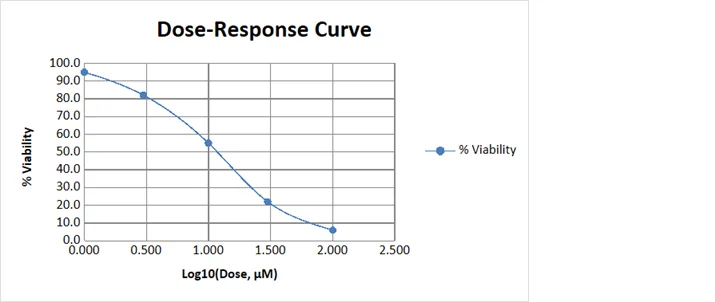
- Test at least three independent experiments and calculate IC50 from full dose–response curves.
Frequently Asked Questions
What is the difference between the MTT and LDH assays?
MTT measures metabolic activity of living cells as an indicator of viability, while LDH measures enzyme released from damaged cells as a direct indicator of cytotoxicity.
Is resazurin better than MTT?
Resazurin is usually more sensitive, faster and non-destructive, so cells can be reused. MTT remains cheaper and is widely used for comparison with published studies and ISO testing.
Can plant extracts interfere with the MTT assay?
Yes. Antioxidants and polyphenols in plant extracts can reduce MTT directly, giving falsely high viability. Always include cell-free controls.
Can I run resazurin and LDH assays on the same cells?
Yes. Take supernatant for the LDH assay first, then add resazurin to the cells for a combined viability and cytotoxicity readout.
Conclusion
MTT, resazurin and LDH assays each answer a different question. MTT and resazurin show how metabolically active cells are, while LDH shows how many cells are damaged. Choosing the right assay for your samples, controlling for interference and combining viability with cytotoxicity measurements delivers accurate, trustworthy in-vitro cytotoxicity data for drug discovery, toxicology and product safety testing.