
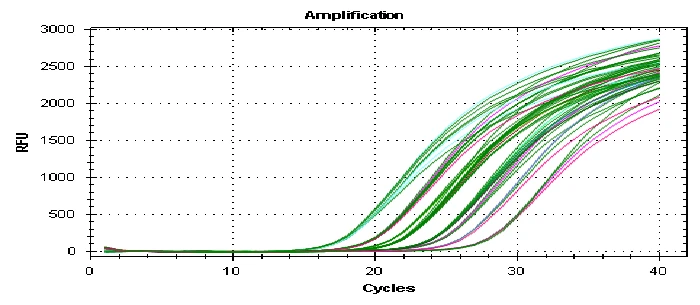
Multiplex qPCR amplifies and detects two or more targets in a single real-time PCR reaction, each with its own fluorescent probe. It saves sample, reagents and time, increases throughput, and lets a target and its reference gene or internal control be measured in the same well, reducing pipetting variation.
But combining assays introduces new challenges: primers competing for reagents, cross-reactivity, spectral overlap and loss of sensitivity. This guide explains how to design, optimise and validate a multiplex qPCR assay that performs as well as its singleplex equivalents.
Common Applications of Multiplex qPCR
- Pathogen detection panels, such as respiratory or food-borne pathogen testing.
- Gene expression with a target and reference gene in the same well.
- Internal amplification controls to detect PCR inhibition and false negatives.
- SNP genotyping and copy number variation analysis.
- GMO detection and species identification.
Step 1: Design Primers and Probes for Multiplexing
- Short amplicons: Keep amplicons around 70–150 bp for efficient, comparable amplification.
- Matched melting temperatures: Design all primers with similar Tm values, and probes several degrees higher than their primers.
- Check every combination: Screen all primers and probes against each other for cross-dimers and hairpins, not just within each pair.
- Specificity: Confirm with in-silico tools such as NCBI Primer-BLAST that each primer set binds only its intended target.
- Probe chemistry: Hydrolysis (TaqMan-type) probes are the standard for multiplex qPCR. MGB or double-quenched probes lower background and improve signal-to-noise.
Intercalating dyes such as SYBR Green cannot tell products apart by colour, so they are rarely used for true multiplex quantification.
Step 2: Choose Fluorophores Carefully
Each target needs its own fluorophore, read in a separate channel of the qPCR instrument.
- Match your instrument: Pick dyes that fit your cycler's excitation and emission filters, for example FAM, HEX or VIC, ROX or Texas Red, and Cy5.
- Minimise spectral overlap: Choose dyes with well-separated emission spectra to reduce crosstalk between channels.
- Bright dye for the weakest target: Assign the brightest dye, usually FAM, to the lowest-abundance target, and dimmer dyes to abundant targets.
- Use dark quenchers: Non-fluorescent quenchers such as BHQ avoid adding background in other channels.
- Watch the passive reference: If your instrument uses ROX as a passive reference dye, do not use a ROX-labelled probe.
- Calibrate: Make sure the instrument is calibrated for every dye in the panel.
Step 3: Validate Each Assay in Singleplex First
Before combining assays, confirm that each one works on its own. Run a standard curve for every target and check that efficiency is 90–110% with R² of at least 0.98. These singleplex results become the benchmark for the multiplex.
Step 4: Choose a Multiplex-Ready Master Mix
Multiple reactions in one tube compete for polymerase, dNTPs and magnesium. Use a master mix formulated for multiplex qPCR, which contains higher concentrations of these components. Optimise magnesium concentration if your mix allows it.
Step 5: Optimise Primer and Probe Concentrations
Primer limiting is the key to successful multiplexing when targets differ greatly in abundance. A highly expressed target, such as a reference gene, can use up reagents early and suppress amplification of rarer targets.
- Limit the abundant target: Reduce primer concentration for the abundant target so it plateaus early without changing its Ct.
- Run a concentration matrix: Test a range of forward and reverse primer concentrations to find the lowest that gives the earliest Ct and strongest signal.
- Tune probe concentrations: Adjust each probe to balance fluorescence across channels.
Step 6: Optimise Cycling Conditions
- Run an annealing temperature gradient and choose the temperature where all targets perform best.
- Consider a slightly longer annealing and extension step to support several reactions at once.
- Keep the same thermal profile used for singleplex validation wherever possible.
Step 7: Validate the Multiplex Assay
- Singleplex vs multiplex comparison: Ct values for each target should closely match their singleplex results, typically within about half a cycle.
- Efficiency and linearity: Run standard curves for every target in the multiplex format; efficiency should stay within 90–110%.
- Competition testing: Test samples with very unequal target ratios, such as a rare target with an abundant reference, to confirm no suppression.
- Crosstalk check: Run each target alone and confirm no signal appears in the other channels.
- Sensitivity: Confirm the limit of detection is not worse than in singleplex.
- Controls: Include no-template controls, positive controls and internal amplification controls.
Troubleshooting Multiplex qPCR
- Delayed Ct for one target: Reagent competition. Apply primer limiting to the abundant target or use a stronger multiplex master mix.
- Signal in the wrong channel: Spectral crosstalk. Recalibrate dyes or choose fluorophores with less overlap.
- Low fluorescence: Increase probe concentration, use a brighter dye, or switch to a double-quenched probe.
- Non-specific amplification: Redesign primers to remove cross-dimers, or raise the annealing temperature.
Frequently Asked Questions
How many targets can be multiplexed in qPCR?
Most real-time PCR instruments support four to six targets per well, depending on the number of optical channels.
What is primer limiting in multiplex qPCR?
Primer limiting means reducing primer concentration for a highly abundant target so it does not use up reagents needed by less abundant targets.
Can SYBR Green be used for multiplex qPCR?
Only in limited cases, by distinguishing products through melt curve peaks. Probe-based chemistry is the standard for reliable multiplex quantification.
How do you validate a multiplex qPCR assay?
Compare Ct values and efficiencies between singleplex and multiplex formats, check crosstalk between channels, and test samples with unequal target ratios.
Conclusion
A well-optimised multiplex qPCR assay delivers the accuracy of singleplex testing with greater speed, throughput and cost efficiency. Careful primer and probe design, smart fluorophore selection, primer limiting, a multiplex-ready master mix and rigorous singleplex-versus-multiplex validation are the keys to reliable, reproducible multiplex real-time PCR results.